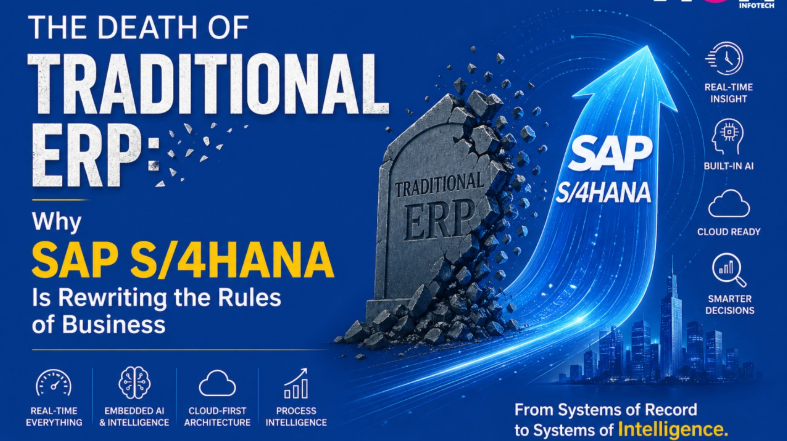
The Death of Traditional ERP: Why SAP S/4HANA Is Rewriting the Rules of Business
For decades, ERP systems were the backbone of enterprise operations. They managed finances, supply chains, and HR — doing the heavy lifting behind the scenes while businesses grew around them. But like mainframes before them, traditional ERP systems are now facing an existential question: Can they survive the age of intelligence?
The short answer is no. And SAP S/4HANA is the clearest signal of what comes next.
The Slow Death of Legacy ERP
Traditional ERP platforms were built for a different world — a world of batch processing, annual upgrades, and on-premise infrastructure. They excelled at recording transactions, not predicting outcomes. They stored data, but rarely surfaced insight.
The result? Businesses spent millions maintaining systems that demanded more than they delivered.
Here’s what legacy ERP looked like in practice:
- Months-long implementation cycles that paralyzed operations.
- Siloed modules that didn’t speak to each other in real time.
- Backward-looking reporting that told you what happened, not what to do next.
- Customizations stacked on customizations, making upgrades nearly impossible.

Sound familiar? You’re not alone. According to Gartner, over 75% of ERP implementations are considered failures in terms of time, budget, or expected value. The problem wasn’t always the people — it was the platform.
Enter SAP S/4HANA: Not an Upgrade. A Reinvention.

SAP S/4HANA isn’t just a newer version of SAP ECC. It’s a ground-up rethinking of what an enterprise system should be in 2024 and beyond.
Built on the SAP HANA in-memory database, S/4HANA eliminates the bottleneck that plagued its predecessors: slow data retrieval. When your entire data model lives in memory, analytics, transactions, and predictions happen in seconds, not hours.
Here’s what that actually means for business:
1. Real-Time Everything
Forget month-end close surprises. With S/4HANA, finance teams get a live, rolling view of the P&L, cash flow, and margin — updated transaction by transaction. The Universal Journal collapses five legacy tables into one, enabling instant reconciliation between FI and CO.
2. Embedded AI and Machine Learning
S/4HANA isn’t just fast — it’s intelligent. SAP has embedded AI directly into core business processes:
- Cash application that auto-matches payments to invoices with 90%+ accuracy
- Demand sensing that adjusts procurement signals based on external signals
- Automated anomaly detection that flags financial irregularities before they become audit issues
This isn’t AI bolted on. It’s AI baked in.
3. Cloud-First Architecture
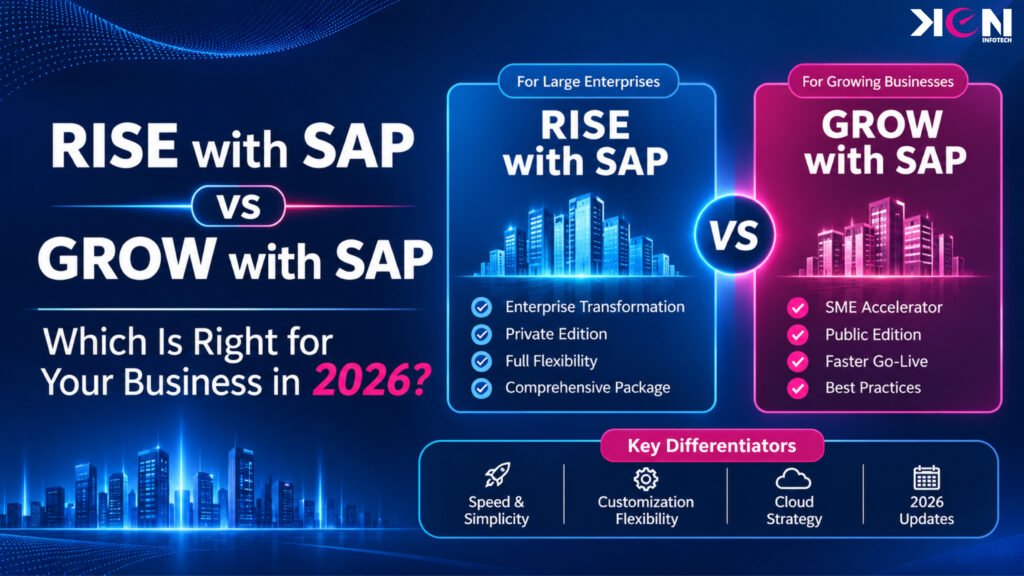
The RISE with SAP program has democratized the path to S/4HANA Cloud. Whether you’re a mid-market manufacturer or a Fortune 500 conglomerate, the entry point has never been more accessible — and the total cost of ownership has never been more justifiable.
4. Process Intelligence via SAP Signavio
One of the most underrated additions to the S/4HANA ecosystem is process mining through SAP Signavio. Organizations can now visualize exactly how their business processes actually run — not how they were designed to run — and use that data to eliminate waste, reduce cycle times, and benchmark against industry standards.
The Business Case Is No Longer Optional
The conversation has shifted. It’s no longer “Should we move to S/4HANA?” — it’s “How fast can we get there before our competitors do?”
Consider this:
- Companies running S/4HANA report up to 50% faster financial close cycles.
- Supply chain teams see 30–40% reduction in operational data latency.
- IT teams spend less time on maintenance and more time on innovation.

The 2027 SAP ECC end-of-mainstream maintenance deadline has added urgency. But the smarter organizations aren’t migrating because they have to — they’re migrating because they want the competitive edge.
The Real Challenge: Change Management, Not Technology
Let’s be honest — the hardest part of any S/4HANA transformation isn’t the technology. SAP’s tooling has matured significantly. Migration accelerators, pre-built industry solutions (SAP Best Practices), and hyperscaler partnerships (AWS, Azure, GCP) have reduced technical risk dramatically.
The real challenge is people and process.
Organizations that succeed with S/4HANA share a common trait: they treat it as a business transformation program, not an IT project. They empower finance leaders, supply chain directors, and COOs to own the outcomes — not just CIOs.
The ones that fail? They lift and shift their old processes into a new system and wonder why nothing changed.
What Leaders Should Be Asking Right Now
If you’re a C-suite executive, transformation leader, or ERP architect, here are the questions worth sitting with:
- Are we running SAP ECC, and do we have a credible S/4HANA roadmap in place?
- Have we assessed our process landscape for transformation readiness — not just technical readiness?
- Are we capturing the value of embedded AI, or are we just replacing one database with another?
- Is our partner ecosystem aligned with our business goals, or just our technical specs?
The organizations asking these questions today will be the ones writing the competitive playbook tomorrow.
Traditional ERP didn’t fail because it was poorly built. It failed because the world outgrew it. SAP S/4HANA represents more than a technology refresh — it’s a philosophical shift from systems of record to systems of intelligence.
The rules of business are being rewritten. The question isn’t whether you’ll adapt.
It’s whether you’ll lead the change — or be caught off guard by it.
Comments