A Safe Move to SmartRecruiters: An Advisory Perspective for SAP SuccessFactors Customers
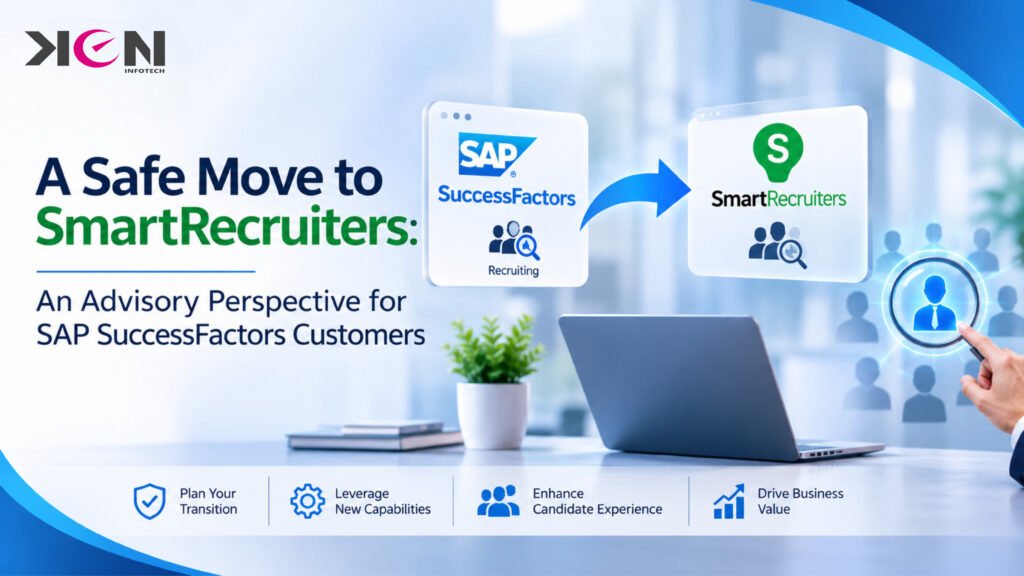
SAP’s acquisition of SmartRecruiters has placed talent acquisition firmly at the center of strategic planning for SAP SuccessFactors customers everywhere. If your recruiters are frustrated with the current UX, your hiring managers are working around clunky approval flows, and candidates are dropping off before they even finish an application — you’re not alone. These are the real conversations happening right now, and they deserve a real answer, not a sales pitch.
A recent webinar on this exact topic, A Safe Move to SmartRecruiters – An Advisory Perspective, drew over 400 registrants. That number tells its own story: customers aren’t chasing hype. They’re looking for clarity.
Is this just a system change — or something more strategic?

Moving from SAP SuccessFactors Recruiting to SmartRecruiters isn’t a technical migration alone. It’s a shift in operating model, user experience, process design, and future roadmap direction. That distinction matters enormously.
Treat it as a one-to-one replacement, and you risk carrying over the same complexity, friction, and outdated design choices into a new platform. Treat it strategically, and the transition becomes a real opportunity to simplify, modernize, and create business value.
SmartRecruiters was built as a modern talent acquisition solution — strong on usability, automation, open APIs, mobile-first design, and collaborative hiring. SAP hasn’t announced a sunset date for SAP SuccessFactors Recruiting, but its innovation roadmap is clearly centered on SmartRecruiters going forward. This is a timing and strategy discussion, not just a feature discussion.
What does the SAP integration roadmap actually look like?
This was one of the most common questions in the webinar — and understanding it is foundational to any credible transition plan.
Phase 1 covers core connectivity between SmartRecruiters and SAP SuccessFactors Employee Central: pushing hire data, position data, and job information into the core HR system without manual re-entry. For organizations already running Employee Central, this is the integration that determines whether the recruiting-to-onboarding handoff is clean or chaotic.
Phase 2 goes further — deeper workflow alignment, stronger reporting continuity, more advanced AI capabilities, and tighter integration with SAP’s broader HCM ecosystem. For organizations with complex global setups, this is where the real architectural decisions surface.
Across large-scale SAP SuccessFactors implementations, one pattern holds consistently: the integration layer is where transitions succeed or stall, not the platform’s raw capability. The limiting factor is almost always the readiness of business rules, workflows, data quality, and governance underneath.
When is the right time to move?
There’s no single model that fits every organization. Some are already pursuing recruiting transformation. Others are mid-project and wondering whether to pivot. Others have complex global setups and need the full picture before acting.
Organizations most likely to benefit from moving early tend to share three things: they’re already considering transformation, they have relatively low dependency on heavily customized recruiting setups, and they’re ready to treat this as a transformation project rather than a swap. More complex organizations can still start planning now — but assessment, not execution, is usually the right next step.
Three transition paths came up repeatedly:
- Big bang — full switch at once. Fast, but high-risk.
- Phased rollout — by country, region, or business unit, allowing controlled change adoption.
- Targeted/partial transition — starting with specific populations or new requisitions, building confidence before a wider rollout.
For most organizations, phased is the most practical route. Parallel approaches are sometimes necessary but add real complexity around candidate experience, career site design, and reporting.
Proof points: what good execution looks like

DSV rolled out SAP HR coverage to 10,000 employees across four countries in six months, winning the SAP Nordic Quality Award for Fast Delivery — built on clear scope, disciplined change management, and a transition model matched to the organization’s reality.
Gist Limited migrated from on-premise SAP ERP HCM to cloud SAP SuccessFactors, reaching 5,000 employees across 26 countries with best-in-class HR tools from the front line to the CEO. The payoff: full workforce and skills visibility, replacing the fragmented data that had limited HR decision-making before.
Aramex delivered its project on time and within scope across 16,000 employees in 65 countries, winning Silver at the EMEA Quality Awards for Innovation Cloud — strengthening HR’s ability to make in-the-moment decisions aligned with business strategy, rather than being boxed in by legacy process.
The lesson carries directly to SmartRecruiters transitions: speed is achievable, but only when the foundations are right.
What should organizations evaluate before moving?
Career sites, integrations, and candidate journeys all need early attention. Common webinar questions: how to manage a career site running two platforms in parallel, what happens to candidate data, how reporting continuity holds up, and what the roadmap means for onboarding and AI.
A few things worth flagging directly:
Running two platforms side by side can fragment the candidate experience without a clear plan for site architecture, navigation, and job distribution.
Candidate data isn’t a simple export-import job. Decide deliberately what belongs in the future-state platform, what stays for compliance, and what gets left behind. Active requisitions and active candidates usually move; the full historical candidate base usually doesn’t need to.
And evaluate SmartRecruiters on value, not novelty: what business problem are we solving, where is the current setup limiting us, and what would better hiring outcomes actually look like here?
Why an independent advisory perspective matters

A transition like this touches recruiting operations, candidate experience, HR data governance, and technology architecture all at once — which is exactly when independent advice, free of implementation revenue targets or sales quotas, matters most.
The organizations that navigate it well start with an honest read of where they stand, not a pitch about where they could be. Treat this as an advisory exercise first, an implementation exercise second: understand the starting point, evaluate business impact, identify where SmartRecruiters creates real value, then choose a path that matches both operating reality and strategic direction.
The right first step
Start with a structured assessment — not a rushed decision, not a speculative migration plan, not an assumption that the new platform needs a like-for-like rebuild.
A grounded assessment should cover the current setup and dependencies, business-critical processes and custom logic, integrations and data flows, candidate and recruiter pain points, future-state needs, SmartRecruiters fit and gaps, transition model options, and realistic cost, risk, and timeline expectations.
The opportunity here is real. So is the need for careful planning. A safe move to SmartRecruiters isn’t about moving fast for the sake of it — it’s about moving with clarity, and with the right partner alongside you.
Comments