From ERP to Intelligent Enterprise: SAP’s AI Journey
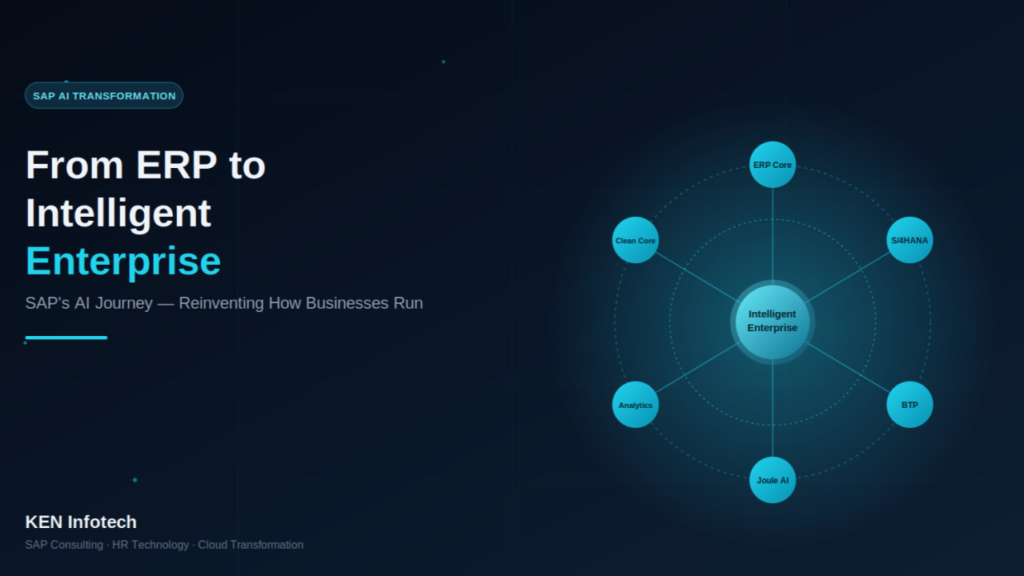
For nearly five decades, SAP has been synonymous with one word: ERP. It was the system of record — the place where finance, supply chain, and HR data lived, got processed, and got reported on. But the SAP of 2026 looks nothing like the SAP of even five years ago. The company has been quietly (and now not-so-quietly) rebuilding itself around a different promise: not just recording what happened in the business, but actively helping run it.
This is SAP’s journey from ERP to Intelligent Enterprise — and it has real implications for how mid-sized businesses plan their next transformation roadmap.
Where It Started: The System of Record Era
Classic ERP was built for a simpler mission — integrate core processes (finance, procurement, manufacturing, HR) into one consistent dataset so businesses didn’t have to reconcile spreadsheets across departments. SAP ECC and its predecessors did this exceptionally well, becoming the backbone of finance and operations for tens of thousands of enterprises.
But this era had a ceiling. ERP told you what happened. It rarely told you what to do next, and it almost never did anything on its own.
The Shift: S/4HANA and the Real-Time Foundation

The move to S/4HANA, built on the in-memory HANA database, was the first real inflection point. Real-time processing replaced batch jobs. Embedded analytics replaced separate reporting layers. This wasn’t just a technical upgrade — it laid the foundation SAP needed before it could credibly talk about AI, because intelligent automation is only as good as the real-time data feeding it.
Alongside this came SAP Business Technology Platform (BTP), which decoupled innovation from the core. Instead of customizing the ERP itself (and creating upgrade headaches for years to come), businesses could extend functionality on BTP while keeping the core “clean.” This Clean Core principle is now central to how SAP wants customers to adopt AI — innovate at the edges, keep the foundation stable.
The Turning Point: Joule and Embedded AI
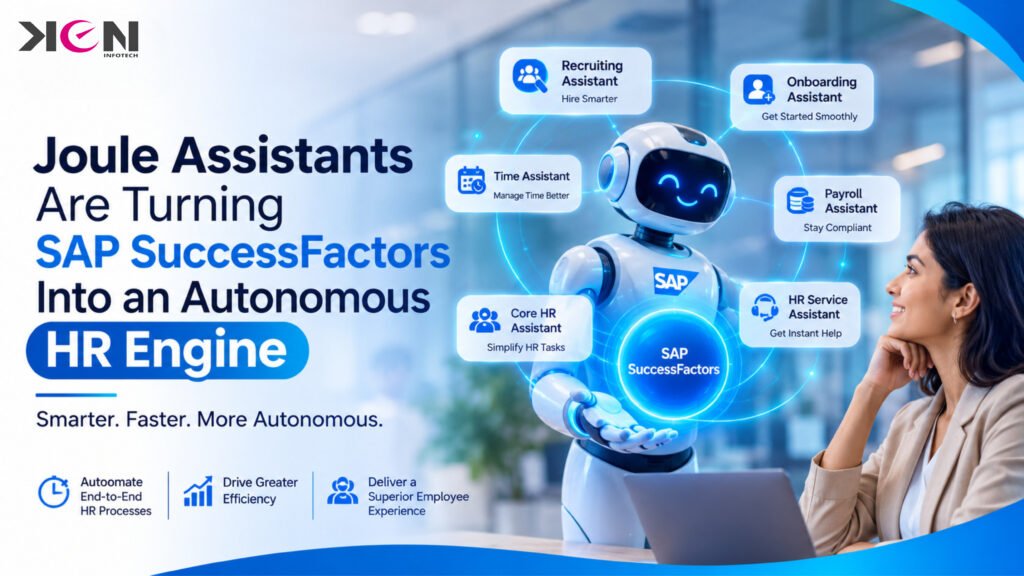
If S/4HANA was the foundation, Joule is the visible face of SAP’s AI ambition. Introduced as SAP’s generative AI copilot, Joule has expanded rapidly — from answering natural-language questions inside SAP applications to now orchestrating multi-step tasks across finance, supply chain, and HR through specialized Joule Agents and Joule Assistants announced at SAP Sapphire 2026.
The shift here is subtle but important: Joule isn’t a chatbot bolted onto SAP. It’s embedded directly into transactional workflows — inside SuccessFactors, inside S/4HANA, inside Ariba — so recommendations and actions happen where the work already occurs, not in a separate tool employees have to remember to open.
What “Intelligent Enterprise” Actually Means
SAP’s Intelligent Enterprise vision rests on a few connected ideas:
- Unified data foundation — SAP Business Data Cloud and BTP bring transactional and analytical data together, so AI has consistent, trustworthy context to reason over.
- Embedded, not bolted-on AI — Joule agents act inside existing processes (approvals, recruiting, forecasting) rather than as a separate destination.
- Agentic workflows — 2026’s Agentic HR and cross-suite Joule Assistants reflect a move from AI that answers questions to AI that completes tasks and hands off between agents.
- Industry and role specificity — Rather than generic AI, SAP is tuning agents for specific roles (recruiter, controller, planner) and industries, increasing relevance and reducing noise.
Why This Matters for Mid-Sized Businesses

Enterprises with smaller IT teams often assume “agentic AI” is a large-enterprise luxury. In practice, SAP’s direction actually lowers the barrier for mid-sized organizations:
- Less custom build required. Pre-built Joule capabilities reduce the need for bespoke AI development.
- Lower governance overhead. Because AI is embedded in SAP’s data model, there’s less risk of ungoverned “shadow AI” tools handling sensitive HR or financial data.
- A phased path. Businesses don’t need to adopt everything at once — starting with one module (say, recruiting via SuccessFactors + Joule) is a realistic entry point.
What to Watch Before You Commit
- Clean Core discipline — legacy customizations can blunt AI benefits; a technical assessment before go-live is essential.
- Data quality and governance — agentic AI amplifies both good and bad data practices.
- Change management — employees need training to trust and correctly use AI-driven recommendations, not just technical enablement.
- Licensing clarity — as SAP bundles more AI capability into its suite, understanding what’s included versus add-on is critical for budgeting.
SAP’s journey from ERP to Intelligent Enterprise isn’t a rebrand — it reflects a genuine architectural shift: real-time data (S/4HANA), an open innovation layer (BTP), and embedded agentic AI (Joule) working together. For businesses evaluating their next SAP roadmap step, the question is no longer “should we adopt AI within SAP?” but “which process should we let SAP’s AI touch first?”
Comments